

Share this Post

Need help with your money or investments? Book a consultation to learn more about working together.
Bonds Aren’t as Safe as You Think
What a Landmark Paper Reveals About Inflation, Taxes, and ‘Risk-Free’ Investing
The bonds in your portfolio may be quietly losing money. This is a closer look at Rob Arnott’s landmark paper ‘Bonds: Why Bother?’ and what it means for your allocation today.
Bonds Aren’t as Safe as You Think
Ask most people to describe a “safe” investment and, without hesitation, they’ll say the same word: bonds.
It’s the story we’ve all been told. Stocks are the thrill ride; bonds are the steady, boring, grown-up part of the portfolio. Put more into bonds as you get older, sleep better at night, and let the “risk-free” side of your money do its quiet job.
There is one problem with that story.
It’s mostly wrong.
And nobody has made that case more powerfully than Robert Arnott — the founder of Research Affiliates and one of the most respected quantitative investors of the last thirty years — in his landmark 2009 paper titled, bluntly, “Bonds: Why Bother?”
If you own bonds, or your advisor keeps recommending them because “you’re getting older,” this is the piece I want you to think about this week.
The Silent Killer: Inflation
Bonds pay you a fixed dollar amount. Inflation quietly shrinks the buying power of every one of those dollars.
Arnott’s paper walks through 200 years of history and shows that the “excess return” of stocks over bonds — the famous 5% equity risk premium your financial planner probably assumes — was actually closer to 2.5% per year. And of that 2.5%, roughly 1.5 percentage points came from inflation eating away at bond returns, not from stocks doing anything particularly heroic.
Now layer taxes on top. The interest you earn on a taxable bond gets taxed as ordinary income — the highest bracket of tax that exists. For a small business owner in a 30% marginal bracket, roughly one-third of every dollar of bond interest is gone before it hits your account.
Here’s what that looks like on the long-term average 10-year Treasury:
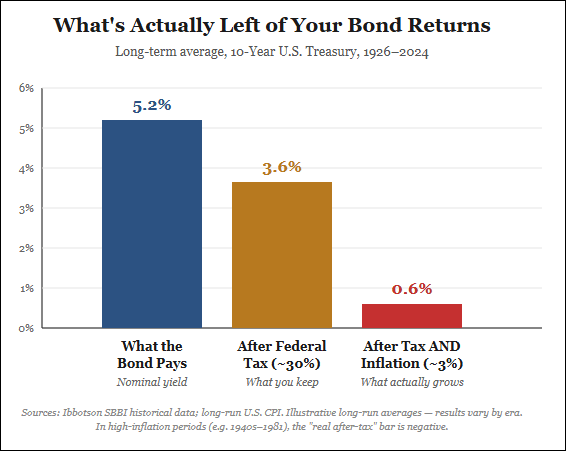
That’s the long-run average. And the “long-run average” is the flattering version of the story. In the high-inflation stretch from the mid-1940s through 1981, this same math produces a negative number — meaning bond investors, in real terms, after taxes, quietly lost money for decades.
The uncomfortable extension of Arnott’s data — one every serious student of markets acknowledges — is this: for most of the modern era, the real, after-tax return on Treasury bonds has been effectively zero, and often negative.
That’s not “safe.” That’s slowly going broke on purpose.
The Other Myths Arnott Punctures
The paper is worth reading in full, but three other findings deserve a moment:
The 60/40 portfolio isn’t really diversified. Arnott shows that the classic 60% stocks / 40% bonds mix has a 98% correlation with the stock market by itself. You’re not diversifying — you’re just holding a slightly smaller position in the same risk.
In 2008, all 16 major asset classes fell together — for two months in a row. It had never happened before in Arnott’s data. The comforting story that “bonds go up when stocks go down” broke, in a hurry, exactly when investors needed it not to.
None of this means bonds are worthless. But the idea that a big bond allocation is automatically the safe, responsible thing to do is a myth, and it’s a myth that has cost investors real money — quietly, one percentage point at a time, for decades.
What This Means for You
If you’re a small business owner or a solopreneur who’s been steered into a heavier bond allocation because of your age, or because “you have enough” — you owe it to yourself to know what those bonds are actually doing for you.
Ask three plain questions:
- What is my bond allocation truly earning me after tax and after inflation? Not the yield on the statement — the real number.
- Am I holding these bonds in the right account? Bond interest is taxed as ordinary income; whenever possible, taxable bonds belong inside a tax-deferred account (IRA, Solo 401(k)) — not in a taxable brokerage.
- Is a piece of what I own in “bonds” actually giving me the diversification I think it is? Or am I paying safety-tax for something that’s 98% correlated with the rest of my portfolio anyway?
If you don’t know the answers, you are not alone. Almost nobody does. The bond side of the portfolio is where most advisors quietly stop paying attention.
How I Can Help
I’m a fiduciary financial advisor based in Hermosa Beach, California, working specifically with solopreneurs and small business owners. I charge a flat fee — not a percentage of your assets — which means I don’t get paid more when your bond allocation gets bigger.
I’d like to look at your portfolio and give you a plain-English read on what your bonds are actually earning after tax and inflation — and whether the mix you’re holding is still the right one for you.
If you would like to discuss your portfolio further, click Book A Meeting.
FAQ: Are Bonds Really a Safe Investment?
1. Are bonds really a safe investment?
Bonds are lower-risk than stocks in terms of default risk — especially U.S. Treasury bonds, which are backed by the federal government. But "safe" and "risk-free" are not the same thing. Bonds carry real risks that don't show up on the surface: inflation risk (fixed interest payments lose purchasing power over time), interest rate risk (bond prices fall when rates rise), and after taxes, the real return on a typical taxable bond can be close to zero or even negative over long stretches of history.
2. Can you lose money investing in bonds?
Yes. You can lose money in bonds in several ways: selling before maturity when interest rates have risen (which lowers the bond's resale price), holding a bond whose issuer defaults, or simply holding a bond through a period where inflation outpaces its fixed interest rate — which quietly erodes your purchasing power even if the account balance never drops. Research by Robert Arnott found that during the high-inflation period from the mid-1940s through 1981, real, after-tax bond returns were negative for decades.
3. How does inflation affect bond returns?
Inflation is one of the biggest threats to bond investors because bonds pay a fixed dollar amount, and inflation steadily reduces what those dollars can buy. Arnott's research found that of the roughly 2.5% average "equity risk premium" (the extra return stocks provide over bonds), about 1.5 percentage points came directly from inflation quietly eating into bond returns — not from stocks performing exceptionally well.
4. Are bonds taxed as ordinary income?
Yes, in most cases. Interest earned on taxable bonds — including corporate bonds and Treasury bonds — is taxed as ordinary income, at your highest marginal tax rate, rather than at the lower capital gains rate that applies to stock gains. For a business owner in a 30% tax bracket, that means roughly a third of every dollar of bond interest is lost to taxes before it ever reaches your account. Municipal bonds are a notable exception, since their interest is generally exempt from federal tax.
5. Do bonds actually diversify a stock portfolio?
Not as much as most investors assume. Arnott's research found that the classic 60% stocks / 40% bonds portfolio has roughly a 98% correlation with the stock market on its own — meaning the bond allocation isn't providing nearly as much true diversification as the "safe" label implies. In periods of extreme market stress, this correlation can break down further: in 2008, all 16 major asset classes Arnott tracked declined together for two consecutive months, something that had never happened before in his data.
6. Should I hold bonds in a taxable account or a retirement account?
Generally, taxable bonds are more tax-efficient when held inside a tax-deferred account, such as an IRA or Solo 401(k), rather than in a regular taxable brokerage account. Because bond interest is taxed as ordinary income, holding bonds in a taxable account creates an ongoing tax drag every year, whereas a tax-deferred account allows that interest to compound without an annual tax bill.
7. Should older investors still shift more of their portfolio into bonds?
The traditional advice — increasing your bond allocation as you age — is worth questioning rather than following automatically. The rationale behind it is real (bonds are typically less volatile day-to-day than stocks), but if bonds are producing a real, after-tax return near zero, a heavier bond allocation may be trading meaningful long-term growth for a sense of safety that doesn't fully hold up, especially for business owners who may have a longer investment horizon than their age alone suggests.
8. What's a safer alternative to traditional bonds if I'm worried about inflation?
Treasury Inflation-Protected Securities (TIPS) are specifically designed to address inflation risk, since their principal value adjusts with the Consumer Price Index. They aren't a perfect substitute for every use of bonds in a portfolio, but they directly address the inflation-erosion problem that traditional fixed-rate bonds don't solve. The right mix depends on your specific tax situation, time horizon, and what role you actually need the bond portion of your portfolio to play.