

Share this Post

Need help with your money or investments? Book a consultation to learn more about working together.
The Illusion of International Diversification
The biggest myth in investing? That international stocks automatically diversify your U.S. portfolio.
For years, we’ve been told that “going global” is a must—that owning international stocks protects you when U.S. markets stumble.
But here’s the truth most investors don’t realize:
👉 Global markets are more correlated today than at any other point in history.
Tracking data over the last two decades shows that when the U.S. market moves, international markets often move with it—sometimes nearly in lockstep.
👉 International stocks haven’t consistently provided downside protection.
During major corrections (2008, 2020, 2022), foreign markets fell just as hard—sometimes harder.
👉 “Diversification” doesn't just mean holding more tickers.
It means building exposure to assets that behave differently—by sector, factor, currency, and economic regime… not just geography.
This doesn’t mean international stocks are bad. It just means they’re not the magic diversifier many believe them to be.
If you want real diversification, you need a strategy rooted in data—not outdated rules of thumb.
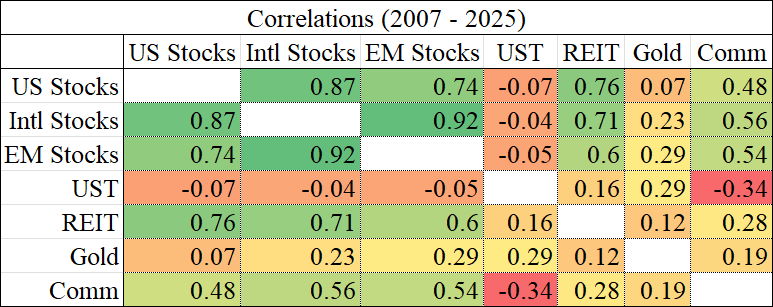
Here is the data:
- International and EM stocks have a high correlation to US Stocks at 0.87 and 0.74 respectively, making them very poor diversifiers.
- US Treasury bonds and gold are very good diversifying assets, with a low or negative correlation to other asset classes.
- Commodities are also valuable as a diversifying asset since they have a low or negative correlation to US Treasury bonds, REITs, and gold.
If you would like to discuss your portfolio further, click Book A Meeting.